The Cloud Isn’t Weightless: Inside the South East’s Data Centre Land Grab
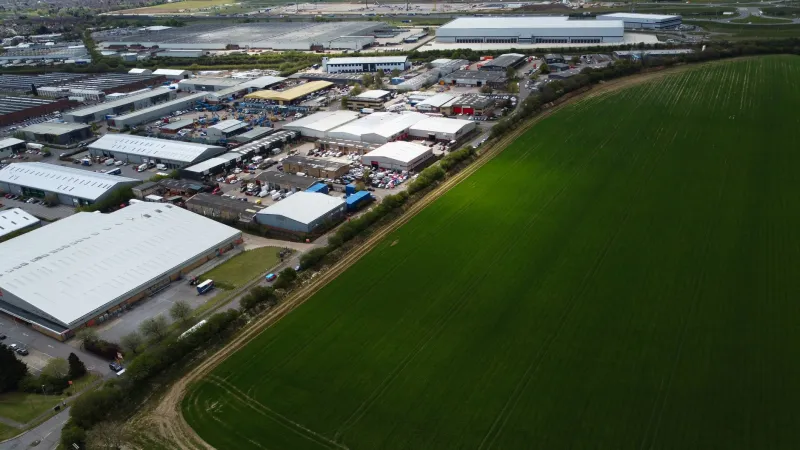
Drive along the M4 past Slough, or take the M3 towards Basingstoke, and you’ll see the sheds getting bigger. Some are warehouses. A growing number are data centres: windowless, humming, and hungry. In 2026, the AI and cloud boom is being sold to the South East as an economic lifeline. Councils are being asked to approve new campuses from Berkshire to Kent, and from Hampshire to Sussex. The pitch is familiar: jobs, business rates, ‘green’ power, and a bit of national importance.
The trouble is that the cloud is not weightless. Every server rack is a claim on the grid, on water, on land, and on the next 20 to 30 years of local carbon budgets. If we don’t scrutinise these applications properly, we’ll lock in demand we can’t square with our climate commitments — and we’ll do it in one of the most water-stressed regions in England.
The South East is the server belt now
Data centres cluster where the fibre is thick, the land is available and the grid can — in theory — be reached. That means the Thames Valley, the M3 corridor, north Hampshire, west Sussex, and the fringes of Kent and Essex. Slough has been a data centre hotspot for years. Reading, Basingstoke, Maidenhead and parts of Oxfordshire are now in the queue. Local plans are being rewritten to make room for more.
Councils often hear that these facilities are ‘critical national infrastructure’ and that refusing them would send a terrible signal. But critical infrastructure still has to fit inside a carbon budget and a water catchment. The fact that AI companies want something does not make it automatically good for the South East.
The greenwash playbook
Most applications arrive with a familiar set of claims. The building will be ‘100% renewable’ or ‘net zero’. It will use ‘efficient cooling’. It will create ‘local jobs’. Some of this may be true in a narrow sense. Much of it collapses under a few sensible questions.
A ‘100% renewable’ claim often means the operator buys renewable electricity certificates or signs a power purchase agreement. That can be a good thing. But it does not mean the data centre adds no new demand to the grid at the exact moment the grid is straining. It does not account for backup diesel generators, which are tested and sometimes run. It does not account for the concrete and steel poured into the building, or the land taken out of agriculture or green belt. And it rarely accounts for the heat that is produced and then dumped into the air rather than piped into a local swimming pool or housing estate.
Then there is water. Many data centres use evaporative cooling, which consumes water rather than just borrowing it. In a region where chalk streams are already under pressure and hosepipe bans have become a summer ritual, that matters. The operator may have an abstraction licence. The question is whether the catchment can afford it, especially when several applications stack up in the same area.
What councils should be asking
Planning committees are not powerless. They have to decide applications on material considerations, and climate change, water resources, biodiversity and transport are all material. So are cumulative impacts. One data centre might be manageable. Five in the same district, each with its own diesel backup and water demand, is a different proposition.
Councillors can ask for an energy strategy that shows real efficiency, not just offsets. They can press for waste heat reuse as a condition of approval. They can demand a water cycle study and evidence that the local catchment can cope. They can ask about grid connection dates and whether the site will need new substations or gas peaking plants. They can scrutinise transport plans, light pollution and noise. They can insist that ‘green’ claims are backed by evidence, not press releases.
Residents can help. Planning portals are public. You can search for applications in your area, read the environmental statement, and submit a comment during the consultation period. You can ask to speak at committee. You can request information under the Freedom of Information Act about correspondence between the council and utility companies. You can ask your MP whether the government’s AI strategy includes any plan for local water and grid capacity. None of this is glamorous. All of it is how decisions actually get made.
Climate justice, not just tech hype
The data centre boom is often framed as a story about technology. It is really a story about power. Who gets to decide what land is used for? Who pays for the grid upgrades? Whose water is being consumed? Who gets the jobs, and who gets the diesel fumes and the traffic? These are climate justice questions, and they belong in the planning system, not in a press release.
None of this means opposing every server in the South East. Digital services matter. But ‘the cloud’ is physical infrastructure, and it should be planned democratically, with real efficiency, genuine renewable power, water reuse, and heat recovery. It should not be waved through on the promise of business rates while the carbon and water bills are handed to the rest of us.
So next time a planning notice appears for a new data centre, read it. Ask questions. Turn up. The cloud may be virtual, but the land grab is very real.