The Runway Con: South East Airports Are Selling Growth, We're Paying in Carbon
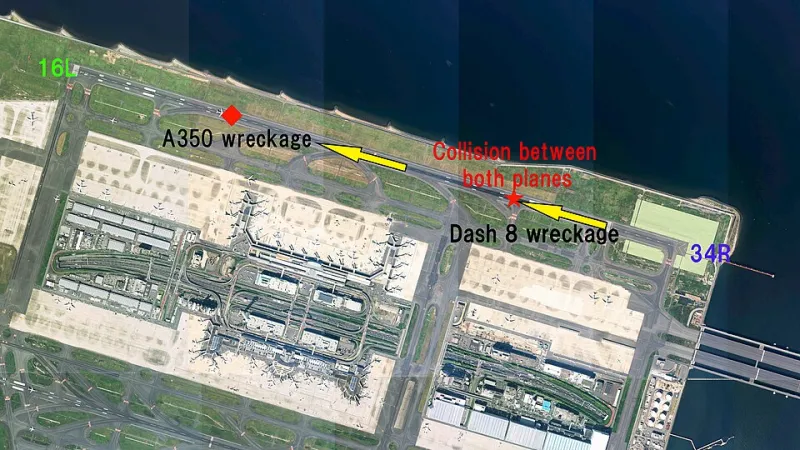
Photo: 国土地理院, Attribution, via Wikimedia Commons
There's a word that appears in every airport expansion document ever written, usually in the first paragraph, usually bolded. Growth. It arrives unexamined, like weather. Growth is good, growth is jobs, growth is what a serious region does. And who could possibly be against growth?
Well. Ask the people under the flight path in Crawley. Ask the parents in Farnborough whose kids' bedrooms now sit under a business-jet approach. Ask anyone who has read a carbon budget and then read an airport masterplan in the same afternoon.
The South East is stuffed with aviation ambitions, and most of them are being sold as inevitable. They aren't. Here's the watchlist, the arithmetic, and the bits where your local group can still make a difference.
What's actually on the table
Gatwick. The big one. The airport's Northern Runway scheme would bring the standby runway into routine use, pushing the passenger ceiling from around 46 million towards 75 million and adding tens of thousands of flights a year. It has been grinding through the national infrastructure process for years now, with decision deadlines sliding about like luggage on a rough landing. Local campaigners have been on it since before most of us knew what a Development Consent Order was.
Farnborough. Business aviation, private jets, and a long-running expansion push to raise the annual movement cap from 50,000 to 140,000 — roughly threefold — over the Hampshire/Surrey border. This is the one people forget, because it isn't holidays. It's someone's Tuesday commute to a meeting.
Southend. A revived easyJet base and a steady drip of new routes, sold as Essex's economic comeback story.
Manston. A cargo airport DCO in east Kent that has spent years bouncing between approval, challenge and stagnation. Cargo runs on night flights, and night flights run on political silence.
Lydd. Freight and passenger ambitions on a shingle bank next to a nature reserve, in a corner of Kent where scrutiny is thin and the wind is loud.
Southampton. The runway extension is built. The longer-haul ambitions haven't gone away.
Biggin Hill and Shoreham. Small aerodromes, private jets and flight schools, over the North Downs and the South Downs respectively. Small does not mean insignificant when you're underneath it.
And hanging over all of it, Heathrow's third runway — which reshapes airspace, stacking and overflight across the whole region, whatever happens to the concrete.
The carbon maths nobody puts in the brochure
Aviation is roughly 2.5 per cent of global CO2. UK aviation accounts for something like 8 per cent of our domestic emissions, and that's before you count the non-CO2 effects — contrails, nitrogen oxides, the cirrus clouds that trap heat at altitude. Factor those in credibly and the effective warming is often reckoned to be two to three times the CO2 figure alone.
Now put growth on top. Government demand forecasts have long assumed aviation passenger numbers climbing for decades. Efficiency gains in the fleet run at maybe 1 to 2 per cent a year. Demand growth wants 3 to 4. The gap has to be closed by something, and the something in every strategy document is called Sustainable Aviation Fuel.
The SAF-shaped hole
The UK has a SAF mandate: a couple of per cent blending now, rising to about 10 per cent by 2030 and 22 per cent by 2040. It's a real policy and it will produce real emission reductions at the margin. It is also constrained by feedstock. Most current SAF is made from used cooking oil and similar wastes — finite, contested, and increasingly wanted by shipping and road freight.
So the honest picture is an industry growing faster than the fuel transition can keep up with, offsetting the difference with efficiency claims and carbon markets of dubious integrity. That is not a climate plan. It's a spreadsheet with a runway attached.
And one more thing worth saying plainly: aviation growth is not widely shared prosperity. A minority of the population takes the overwhelming majority of flights, while the noise, the air quality damage and the climate cost land on people who fly least. Selling that as growth for the region is a stretch, to put it politely.
Planning is where it dies or flies
Here's the frustrating bit. Councils have climate duties. They declare climate emergencies, they write carbon budgets into local plans, they publish glossy net zero pathways. And then a major airport application lands, and aviation emissions sit largely outside the local authority's carbon accounting. The numbers that would sink the case simply aren't in the box the council is required to tick.
That's a gap campaigners can exploit, because it is a gap made of questions. What emissions assessment did the council commission? Did it include non-CO2 effects? Did anyone model the scenario where demand doesn't grow as forecast? Why does the local plan's housing allocation assume a runway that doesn't have consent?
How to be useful before the next deadline
- Find out what's live near you. DCO examinations have statutory windows for written representations and hearings. Local plan consultations run on their own clock. Missing a deadline is the most common way campaigns lose.
- FOI the council. Ask for aviation emissions modelling, officer advice on climate duties, and correspondence with the airport operator. Ask early — responses take a month even when they're helpful.
- Go to the consultative committees. Every significant airport has one. They are dull, they are public, and they are where noise complaints and expansion assumptions get recorded in the minutes.
- Widen the argument past carbon. Noise, night flights, air quality, housing pressure, road congestion. Coalitions are built on the issues people feel at 5am when the first departure goes over.
- Refuse the SAF absolution. Any consultation response that says aviation can grow sustainably should be met with one question: on what feedstock, at what scale, verified by whom?
- Link up. Local groups have been doing this for years and they know the file references. Don't reinvent the wheel; bring hands.
None of this is a lost cause. Airports get built because nobody turns up to the examination, nobody reads the local plan, and nobody asks the awkward question about what happens to the carbon budget when the passenger cap doubles. Turn up. Ask the question. The runway is not inevitable — it's just well funded.
This is an opinion piece. It reflects the view of the author and of XR South East, not necessarily of any airport's PR department.