Sorted, Shipped, Vanished: Where the South East's Recycling Actually Goes
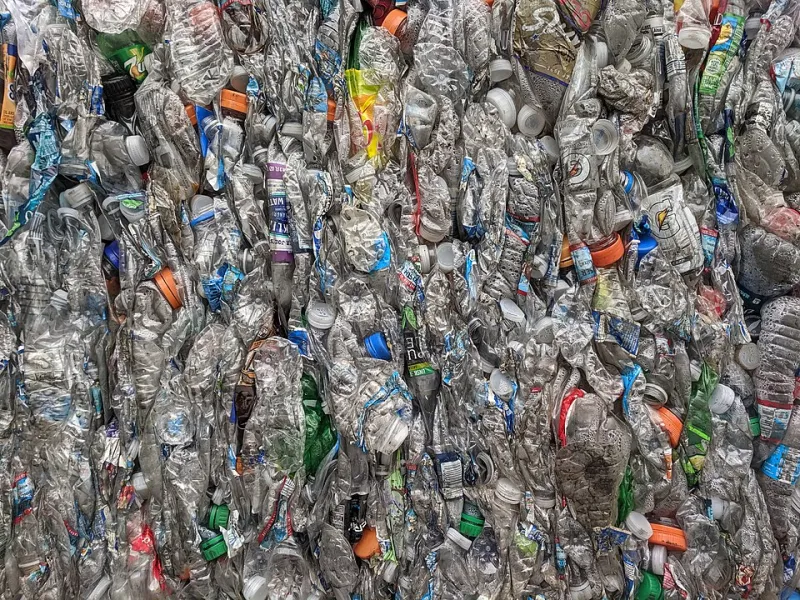
Photo: Grendelkhan, CC BY-SA 4.0, via Wikimedia Commons
There's a moment on every collection round when the story stops. The lorry pulls away, the bin goes back out, and the rest of the journey — the sorting plant, the baler, the port, the ship — happens in a fog of council press releases and contractor spin.
For most of us in the South East, that fog is the whole story. We get a percentage in a waste strategy document and a sticker on the bin, and we're supposed to feel sorted. But recycling isn't a moral act performed at the kerbside. It's an industrial supply chain, and like every supply chain it has carbon in it, labour in it, and a set of contracts someone would rather you didn't read.
The bin lorry is where the public record ends
Ask your council what happens to your mixed recycling and you'll usually get a decent answer up to the Materials Recovery Facility. After that, things get vague. Bales get sold. Bales get traded. Bales get blended, brokered and re-labelled, and by the time they hit a dock in Southampton, Sheerness or Dover, the paperwork has been through more hands than the plastic has.
The Environment Agency publishes export data, but it's partial, lagging, and built around a self-declared accreditation system for packaging exporters. Councils publish recycling rates, which are calculated at the point of collection or sorting — not at the point of final reprocessing. That gap is where the whole illusion lives. A tonne counted as "recycled" in Hampshire can be landfilled in Turkey, burned in a cement kiln in Poland, or quietly downcycled into a low-grade product that gets dumped within a year.
None of that is a rounding error. It's the difference between climate policy and waste accounting.
Where it actually goes
Broadly, South East recyclables split three ways: reprocessed in the UK, reprocessed in the EU (mostly the Netherlands and Germany for plastics and paper), and shipped further afield — Turkey, Malaysia, Indonesia, Vietnam, India — where the environmental and labour standards are, to put it politely, not equivalent.
The Basel Convention amendments that came into force in 2021 were supposed to tighten the rules on plastic waste shipments, and to be fair they did reduce the worst of the traffic. What they didn't do is create a duty of care that survives a chain of brokers. A load can leave these shores legal and arrive somewhere it absolutely shouldn't be, and everyone in the middle can shrug.
And here's the bit that should bother us most: exporting waste shifts the carbon accounting offshore. The emissions from reprocessing, the pollution from informal recycling, the burning of rejects — none of it lands on your council's carbon budget. It lands on the lungs of someone in Adana or Jeneponto. That is a climate justice problem dressed up as a recycling success story.
Burning isn't recycling, and downcycling isn't either
We've written before about the incinerator boom across the region, and the two issues are welded together. The more councils commit to energy-from-waste capacity, the more they need feedstock to keep those plants running. Guess what competes for that feedstock. Guess whose contract terms reward tonnage over quality.
Downcycling is the quieter scandal. A plastic bottle can become a park bench; a park bench can't become a bottle. Mixed, contaminated, multi-layer packaging gets "recycled" into a product with one more life in it at best, and often that product is a low-value item exported again or sent to landfill. Technically recycled. Practically a delay.
Who's least transparent
There's a genuinely useful league table waiting to be written here, and it's not about recycling rates. It's about disclosure.
Some South East authorities publish their waste disposal contracts and end-destination data in full. Others publish a glossy page about "closing the loop" and then refuse a Freedom of Information request on commercial grounds. District and borough councils — the ones actually collecting — often have no idea where their waste ends up, because the disposal contract sits with the county. That split is a transparency trap, and it's been designed by nobody in particular and exploited by everybody.
The big contractors know exactly how this works. Veolia, Biffa, Suez, Viridor, Cory — these are sophisticated operators with sophisticated communications teams, and they are not obliged to tell you the destination of a bale once it's sold on the open market. "Commercially sensitive" is the phrase. It means: not your business.
Except it is our business. It's public money, public waste, and a public climate target.
What a real local waste audit would look like
Forget the sticker campaign. A proper audit asks five questions: where did this tonne physically go, who handled it at each stage, what was rejected at the far end, what emissions were generated across the whole journey, and what were the labour conditions at final reprocessing. If a council can't answer those, it isn't recycling — it's posting.
Five things rebels can do before spring
- FOI your council for waste disposal contracts, end-destination reporting and reject rates. Ask specifically for final reprocessing locations, not just "UK and abroad".
- Ask your councillor a direct question at full council: what percentage of our recycling is reprocessed within 200 miles of the borough? Watch what happens.
- Push for a plastics reduction strategy rather than a recycling improvement plan. The cheapest tonne is the one that never gets made.
- Link up across borders — Kent, Sussex and Hampshire all feed the same ports. A regional transparency campaign is harder to ignore than three separate ones.
- Show up for the waste plan consultations. They're dry, they're buried on council websites, and they are where the next decade of contracts gets locked in.
The bin is not a policy
The blue bin is a good habit wrapped around a bad system. It asks us to feel responsible for a supply chain we can't see, governed by contracts we can't read, delivering outcomes we can't verify.
Rebellion, in this corner of the movement, means refusing that deal. Not refusing to recycle — refusing to let "we recycle" be the end of the sentence. Follow the bale. Read the contract. Ask the question that makes the press officer sigh.
Because if the destination is secret, the recycling probably isn't what they told you it was.