The Shed Belt: Who Actually Signed Off the South East's Warehouse Boom?
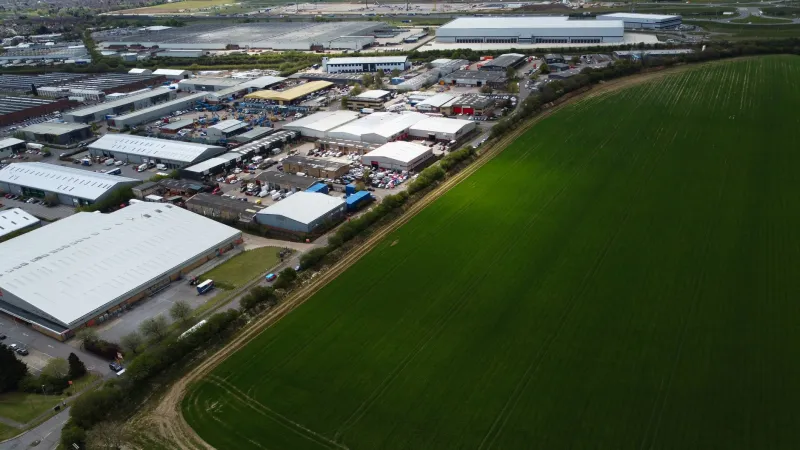
There's a particular view from the top of the A2 near Faversham, and another one on the ridge above Basingstoke, and a third that will greet you soon enough on the back lanes of mid-Sussex. You crest a rise, expecting fields, and instead you get a grey horizontal plane of roof lights stretching to the horizon. A shed. Except it isn't a shed. It's a hundred thousand square metres of concrete, steel and pallets, and it's about to be your neighbour.
We're not short of things to be furious about in the South East — water, buses, incinerators, airports. But the warehouse boom is the one that keeps slipping through because it arrives dressed as good news. Nobody protests a job. Nobody marches against a business rates receipt. And yet, hectare by hectare, it's the quietest, fastest land-use change in the region.
A shed the size of a village
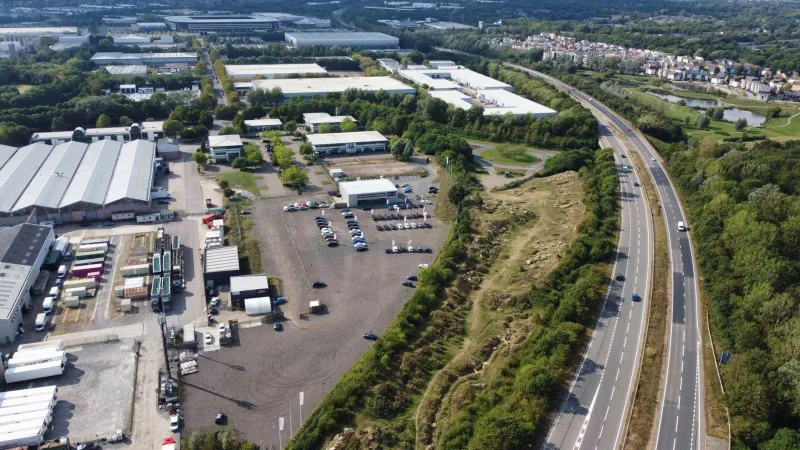
Let's do the scale honestly. The big logistics parks going through planning across Kent, Hampshire, Surrey, Buckinghamshire and Oxfordshire routinely run to 60,000–100,000 square metres of floorspace. Some of them are taller than a four-storey block. Add the yard, the HGV circulation, the staff car park and the attenuation pond and you're looking at a site that is functionally a small settlement, minus the school, the GP, the pub, the bus and the people who stay.
Some come with a name that sounds like a business park and a render full of trees that will not exist for a decade. Others are billed as "logistics hubs" or "distribution centres" or, my personal favourite, "employment-led mixed use" — a phrase that means warehouses plus a drive-thru.
And they generate traffic the way a motorway junction generates traffic. A single large distribution facility can put hundreds of HGV movements on local A-roads every day, plus the shift-change surge of cars at 6am and 2pm, plus the white vans doing the last mile to your doorstep. Which is, of course, the point of them. The boom isn't an accident; it's the physical shape of next-day delivery, and we are all, collectively, the demand.
'Jobs and growth' — the two words that end the conversation
Here's the pattern at committee after committee. The applicant's agent stands up, thanks the chair, and says the magic words: hundreds of jobs, millions of pounds of investment, an apprenticeship pledge, a footpath improvement, a new bus stop that may or may not ever see a bus. Then a councillor says something about the local plan and housing targets, someone mentions business rates, and the officers' report recommends approval subject to a section 106 agreement.
What almost never gets mentioned in the same breath is job density. Warehouses are among the least labour-intensive land uses we build. You can fit an awful lot of floorspace onto one job — the numbers typically land somewhere around one employee per 70 to 100 square metres, and automation is quietly pushing that ratio the wrong way. The jobs that do exist are real and they matter, but they are heavily agency-mediated, shift-based, night-inclusive and physically punishing. Arguing that a shed on green belt is a community benefit because it will employ a few hundred people is a bit like arguing that a motorway service station is a cultural amenity.
Who actually says yes
This is where people get vague, and vagueness is how it survives. So, concretely:
The district or borough planning committee. This is the decision point for most schemes. Councillors, not officers, vote — and they are allowed to vote against officer recommendations if they have planning reasons, including climate and landscape harm. They mostly don't. Turnout at these meetings is usually a handful of residents and a dog.
The local plan. Every district is currently rewriting or reviewing its plan, and each one contains an "employment land" target — a number, in hectares, that someone has decided the area needs. Those numbers are the engine of the whole thing. If the employment land target is generous, developers don't have to fight; they just point at the plan.
National policy. The changes to the National Planning Policy Framework brought in from late 2024 and refined through 2025 made green belt release easier to argue, including through the new "grey belt" category, and put more pressure on councils to demonstrate a five-year land supply. That pressure is the reason a field you thought was protected suddenly has a scoping opinion on the council website.
The county and the combined authorities. Highways objections carry real weight, and so do the economic growth officers whose job is to say yes to investment. A shed that a district could refuse on landscape grounds often arrives pre-blessed by a strategic "growth" document nobody has read.
The Secretary of State. Call-in and appeal. It's the backstop, and it's been used — but rarely in favour of the field.
The climate maths that never makes the report
Every council in the South East has declared a climate emergency. Almost all of them will approve warehouses on green belt anyway, and they will do it while quoting a carbon assessment that conveniently stops at the site boundary.
Here's what gets left out. The soil carbon and the agricultural productivity of the land being sealed. The embedded carbon of the slab and the steel. The transport carbon of hundreds of daily HGV movements and the diesel idling in the yard. The air quality on the nearest A-road, where nitrogen dioxide levels are already scraping the limit. The light pollution that never switches off. The run-off, on clay, in a region where surface water flooding is now an annual event rather than a headline.
Biodiversity net gain was supposed to be the answer. In practice it's a 10% offset that can be met by buying credits from a habitat bank twenty miles away, with a thirty-year management plan enforced by a council that has already cut its ecology team to one and a half people. It is better than nothing. It is not a reason to pour concrete on a field.
What you can actually do — and when
The good news is that warehouses are unusually beatable at the local level, because unlike an airport or a motorway, they don't have a national cheerleader. They need a committee to say yes. Committees get nervous when the room is full.
- Find the application before the consultation closes. Most districts publish weekly lists. Sign up for them. The statutory consultation window is short and the deadline is real.
- Read the employment land evidence base in your local plan. It's boring, it's long, and it's where the numbers are set. Comment on it during the regulation 18 or 19 stage — that's the point of maximum leverage, well before any shed is drawn.
- Register to speak at planning committee. Usually three minutes. Use them. Give planning reasons: landscape, air quality, highways capacity, carbon, flood risk — not "we don't like it".
- Ask the questions officers' reports tend to skip. How many HGV movements per day, at what hours, on which roads? What's the job density, and what proportion is agency? What's the travel plan, and is there a bus, or an aspiration of a bus? What happens to the BNG if the habitat bank fails?
- Write to your ward councillors, not just the planning department. They vote. They also read their email at 11pm.
- FOI the correspondence. Who lobbied for this site, and when? Option agreements on agricultural land are public-interest documents, and land promotion is a business with a paper trail.
None of this is glamorous. It's PDFs, deadlines and a village hall at 7pm. But it's where the South East's green belt is actually being decided — not in Westminster, not in a headline, but in a committee room with twelve empty chairs and a stack of officer reports.
Bring friends. Fill the chairs. Make them say the words out loud.
XR South East runs planning-watch sessions for local groups. If your area has a logistics scheme brewing, get in touch.