Rooftops First: The South East's Solar Boom Is Looking in the Wrong Direction
There's a rhythm to it now. A laminated notice on a telegraph pole. A Facebook group with a name like "Save Our Fields (Not Against Solar)". A village hall packed on a Tuesday night, half the room worried about hedgerows, the other half worried about being called a nimby for saying so.
Then the developer's consultation boards come out, the numbers are big, the trees are photogenic, and everybody goes home no wiser about the thing that actually matters: who owns the electricity, and who owns the land under it.
We keep getting handed the same fight. Farmland versus panels. Food versus carbon. Countryside versus climate. It's a rubbish framing, and it's not the one we should be having.
The wrong end of the telescope
Solar needs land. Nobody serious denies that. The UK cannot hit its climate targets on domestic roofs alone, and pretending otherwise is a fantasy that suits people who'd rather we built nothing.
But the South East's planning pipeline is heavily weighted toward greenfield sites, and that's not an accident of geography. It's an accident of economics and queue mechanics. Big sites are simpler to finance. One developer, one grid connection, one landowner, one contract. A distribution network operator under pressure can deal with one 200-hectare application far more easily than with four thousand separate rooftop connections across Kent, Sussex and Hampshire.
So the path of least resistance runs straight through a field. Not because the field is the best place for a panel, but because the field is the cheapest place to do the paperwork.
And the land-use costs land somewhere. Sometimes on grade 1 agricultural soil. Sometimes on land that's been permanent pasture for generations, which stores carbon perfectly well on its own, thanks. Sometimes on a site next to a marsh or a floodplain where the biodiversity ledger gets very creative very fast — Cleve Hill near Faversham is the reference point everyone in this region now argues about, and for good reason.
Meanwhile, look up
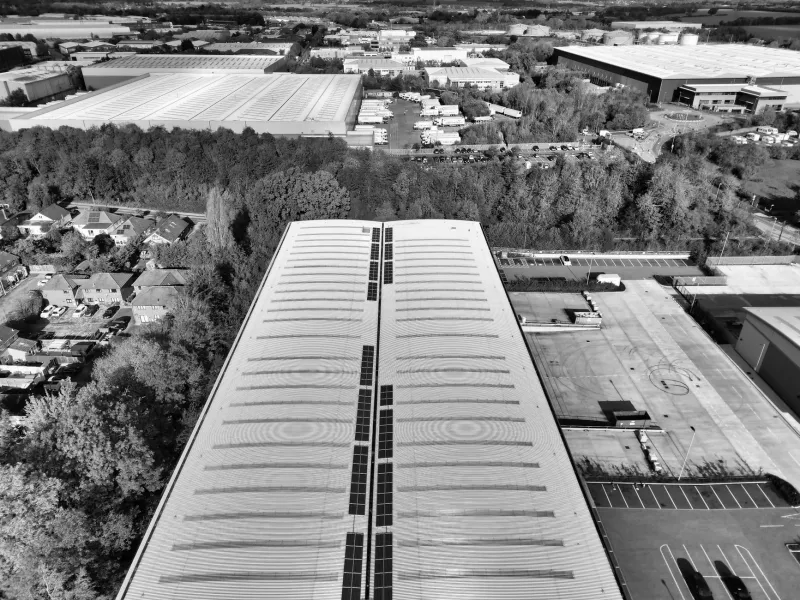
Here's the bit that makes people genuinely angry once they see it. We are having this entire, exhausting, hedgerow-by-hedgerow argument while thousands of hectares of genuinely low-conflict surface sit empty above our heads and under our feet.
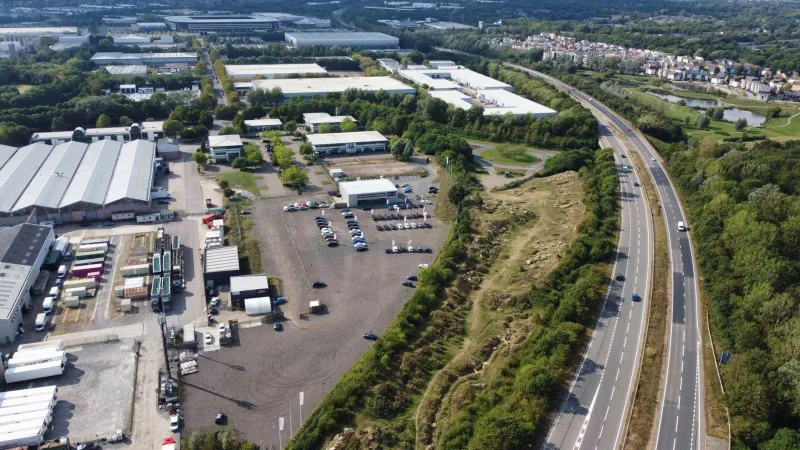
Retail parks. Distribution centres. Car parks from Ashford to Basingstoke. Schools, leisure centres, hospitals, council depots. Barn roofs, milking parlour roofs, grain store roofs. Bus shelters. The long, flat, entirely uncontested roofs of industrial estates along the M20 and the A3.
None of it is controversial. All of it is close to where the power is actually used. And a shocking amount of it is still bare.
Some of this is a grid problem. Some of it is a landlord problem — a warehouse owner on a ten-year lease has little reason to spend capital on a roof they'll sell before it pays back. Some of it is a council problem, where the estates team and the climate team have never been in the same meeting. Some of it is a financing problem, because forty small projects need forty sets of paperwork and nobody's bonus depends on that.
Fixable problems, in other words. All of them. Which makes "we had no choice but to concrete the Weald" a fairly weak defence.
A cheque is not a stake
Then there's the community benefit question, which is where the current model gets slippery.
Most large solar applications in the South East now arrive with an offer attached. A community fund, a few thousand pounds a year per megawatt, a village hall refurbishment, some new playground equipment. It's not nothing, and it's often genuinely welcome.
But a cheque is not a stake. A fund run by a developer, with a community liaison officer and an annual photo op, is not the same as residents owning a share of the asset on their land. One is a sweetener. The other is wealth that stays in the parish for the next thirty years.
We already know what the better version looks like. Westmill Solar in Oxfordshire is the obvious template — genuinely community-owned, and it has spent a decade proving that co-operative energy isn't a hobby. The South East has co-ops doing similar work on a smaller scale, and every single one of them will tell you the same thing: the barrier isn't public appetite, it's capital, grid access and the sheer grind of the planning system.
So when the next application lands on your parish council's desk, this is the question worth asking. Not "how much is the fund" but "who holds the equity, and can we buy into it?"
What to actually do when the boards go up
If a solar application arrives in your area — and statistically, it probably will — here's a practical starting point.
- Ask for the alternatives. Have the developer and the council assessed rooftop and brownfield capacity in the district? Get that in writing. If the answer is "not our remit", that's a finding, not a dead end.
- Ask about the land. Which agricultural grade is it? Is it in a national park, an AONB or a floodplain? What's the soil carbon and the biodiversity baseline? Independent assessment, not the developer's own ecology consultant's optimistic summary.
- Ask about ownership. Community fund, community stake, or community shareholder? Push for the third one. Push hard.
- Ask about the grid. Is the connection actually available, or is this speculative? A solar farm that sits unbuilt in a connection queue for eight years is a land deal, not a climate solution.
- Ask your council about its own roofs. Every council in the South East should be able to publish a list of its buildings with solar potential and a timetable. Most can't. That's a campaign in itself, and it's a lot more winnable than fighting a 300-hectare application on your own.
- Don't take the bait. The moment you say "not here", someone will call you anti-renewable and the whole conversation collapses. Be the people who said "yes, and here instead, and with us owning a bit of it."
Speed and shape are not opposites
There's a temptation, in a movement that is rightly furious about timelines, to say that any delay is a betrayal. Solar needs to go up fast. That part is true.
But fast and fair aren't in conflict — not really. A rooftop-first rollout is quicker to connect, quicker to build, and generates power right where the demand is. A co-operative model spreads the money around instead of concentrating it in the hands of a handful of developers and landowners who spotted the subsidy signal early.
The slow, contested, field-by-field route we're on now is what happens when you let the planning system and the grid queue pick the winners for you. It burns years, it burns goodwill, and it hands a genuine climate necessity to people who'd quite like to turn it into another culture war.
So yes: more solar, faster than the government is currently managing. But let's stop pretending the only place it can go is a field near you. The sun hits the roofs first anyway. It's about time we let it.