Before the Banner: A South East Protest Law Primer for 2026
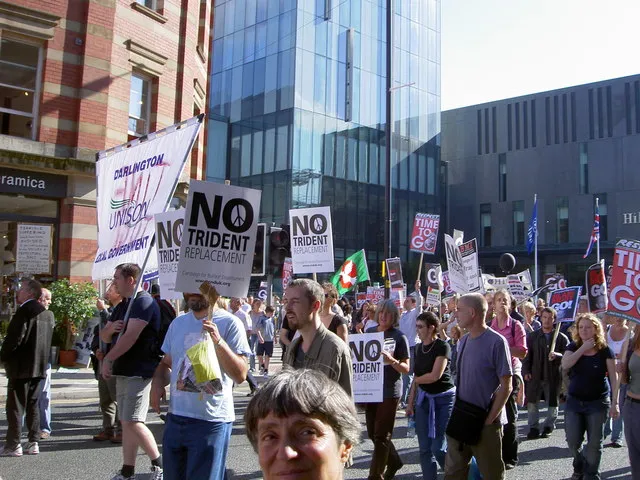
Photo: Keith Williamson, CC BY-SA 2.0, via Wikimedia Commons
Let's start with the obvious: this is not legal advice. We're not solicitors, and nothing below replaces a proper briefing from a duty solicitor, a legal observer team or the arrestee support crew in your area. What it is, though, is the stuff people tend to learn in the worst possible order — usually handcuffed, in a van, on the way to a custody suite. Learn it now instead.
The legal picture for protesters across the South East has been tightened piece by piece over the last few years, and 2026 is the year to get fluent in it. Plans for spring actions in Brighton, Kent and the Hampshire coast are already on the table. If you're going to put your body on the line, you may as well know what's wrapped around it.
The ground has shifted, and it hasn't shifted back
Since the Public Order Act 2023 landed, the threshold for police imposing conditions on a demo has dropped sharply. Where officers once had to reasonably believe an assembly would cause "serious public disorder, serious damage to property or serious disruption to the life of the community", the test now bites at "more than minor" disruption. That phrasing matters enormously. A handful of people with a banner and a slow walk can, on a bad day, clear it.
The 2023 Act also brought in a suite of standalone offences: locking on, being equipped to lock on, tunnelling, obstructing major transport works, interfering with key national infrastructure. There are Serious Disruption Prevention Orders too, aimed at people with repeated protest convictions. None of this is ancient history — it's the water you're swimming in.
Add the older furniture that never went away: wilful obstruction of the highway under the Highways Act 1980, section 5 of the Public Order Act (harassment, alarm or distress), breach of the peace, and the various railway byelaws that get dusted off whenever someone looks at a level crossing.
Conditions: the bit that catches the most people
Conditions are nearly always how demonstrations get policed now — not bans, conditions. A route change, a time limit, a sound restriction, a requirement to stay behind a barrier on a specific patch of tarmac nobody wanted.
The critical thing to understand: once conditions are lawfully imposed, breaching them is a criminal offence, and the offence is committed by the individual who breaks them. Not by the organiser. Not by the crowd. You.
So when a senior officer in a hi-vis announces something over a loudhailer, three questions are worth asking (and worth having a designated person ask, calmly, on the record): what exactly is being imposed, on whom, and under which power? Legal observer teams across Sussex, Kent and Surrey train for precisely this — capturing the wording verbatim, with a timestamp.
Stop and search: what you're being asked for, and what you aren't
You can be searched on the way to an action. Sometimes with grounds — under section 1 of PACE, or section 23 of the Misuse of Drugs Act — and sometimes without individual grounds at all, under section 60 of the Criminal Justice and Public Order Act, if a senior officer has authorised a search zone.
In either case: ask which power is being used. Ask for the officer's name and number, and the station they're based at. Ask for the grounds if grounds are required. You are entitled to a receipt for anything seized. You do not have to be polite about any of this, but it tends to go faster if you are.
One practical thing people forget: what you carry can be evidence. A notebook of plans, a bag of D-locks, rope, a change of clothes, a printout of the action plan — all of it can be read as "equipped to" something. Think about what's actually necessary before you pack it.
Liaison: use them, don't trust them
Police liaison officers are a real and often useful channel — for negotiating welfare, toilets, water, medical access and safe routes out. Some of them are decent. Some are collecting information. Both things can be true of the same person on the same afternoon.
So: keep liaison conversations operational, not confessional. Don't speculate about numbers, tactics or who's doing what. Don't name people. Have one or two designated liaison contacts rather than a rotating cast, and write up what was said afterwards while it's fresh.
And remember the asymmetry. Anything you say to a liaison officer can end up in an operational log. That log can end up in a court bundle three years later. Speak accordingly.
If it goes wrong: arrest and the hours after
If you're arrested, the clock starts. You'll be taken to custody, booked in, and offered a solicitor — always take the solicitor. It's free, it's your right, and "no comment" is a perfectly lawful answer while you wait.
You don't have to explain yourself at the roadside. You don't have to give a "significant statement" in the van. The pressure to chat is the point; the silence is the strategy. Give your details as required, then say you'd like to speak to a solicitor.
This is where arrestee support matters enormously, and it's one of the quiet achievements of the movement in the South East. Local XR groups have built phone trees: who's got the keys, who's collecting from the station, who's calling the flatmate, who's got a lift home at 2am. National outfits like Green and Black Cross run legal observer training and produce know-your-rights materials worth carrying folded in a pocket.
Post-arrest, expect bail or release under investigation, possibly with conditions attached — no-go areas, curfews, restrictions on contacting named people. Read them. Then get them checked by a solicitor, because conditions can be varied and sometimes shouldn't have been imposed at all.
Do the boring prep now
So: know your group's legal support contact before the action, not after. Save the number in your phone under something unremarkable. Tell someone where you're going. Write a solicitor's number on your forearm in biro if that's what it takes. Have a plan for your medication, your kids, your dog and your shift pattern.
And talk about it. The single best protection for a protest movement isn't secrecy — it's a membership that knows the law well enough to stay calm while it's being applied to them.
The law in 2026 is harsher than it should be. That's a reason to be informed, not a reason to stay home. See you out there.