Bedpans and Heatwaves: What 40°C Would Actually Do to South East Health Services
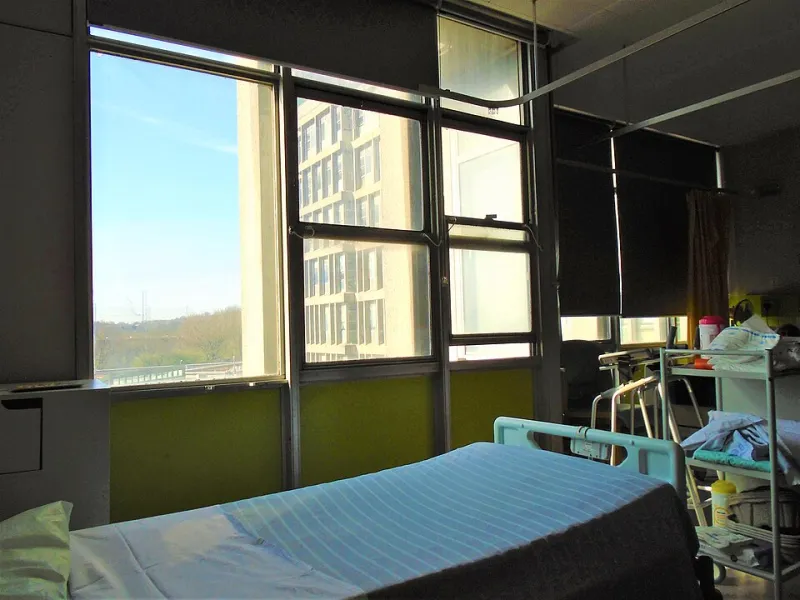
Photo: Kolforn (Kolforn) I'd appreciate if you could mail me ([email protected]) if you want to use this picture out of the Wikimedia project scope. This file is licensed under the Creative Commons Attribution-Share Alike 4.0 International license. Yo
When the UK passed 40°C for the first time in July 2022, the record fell at Coningsby in Lincolnshire. In the South East the mercury stopped just short, but the effects did not: cancelled appointments, crews waiting in roasting cabs, care homes ringing round for fans, and staff describing wards they could not cool down because the windows were sealed and the building had been designed in 1974.
That was a one-off, we were told. It was not. It was a preview, and the region's health estate has not been rebuilt in the four years since.
Built for a different century
The South East's NHS estate is a patchwork of Victorian infirmaries, 1960s and 70s district general hospitals with deep-plan wards and no mechanical cooling, PFI buildings with maintenance contracts nobody can afford to vary, and a large stock of leased and converted buildings that were never designed for clinical use at all. Add in thousands of care homes, the overwhelming majority privately run and operating on thin margins, plus GP surgeries in converted houses with single-glazed south-facing consulting rooms.
The net zero agenda has, understandably, focused on carbon. But a hospital can cut its emissions and still cook its patients. Adaptation is the quieter half of the climate plan, and it is the half that gets cut when the capital budget is squeezed, because a chiller unit does not photograph as well as a solar array.
Who overheats first
The answer is not "everyone equally", and that is the justice point at the centre of this.
Older people, very young children, people with cardiovascular or respiratory disease, people on medication that affects thermoregulation, pregnant people, and anyone with limited mobility or cognition are at elevated risk in heat. So are people in poor-quality housing, which in the South East means overheated flats above shops, converted lofts, and homes with no shading and no cross-ventilation.
Then there are the people caring for them. Care workers moving between clients in cars with no air conditioning. District nurses covering rural patches across Kent and Sussex. Ambulance crews on long waits outside hospitals, and hospital porters moving patients through corridors that are cooler outside than in.
A heat plan that lists vulnerable groups but not the workforce is only half a plan.
Paper plans and real thermometers
The UK Health Security Agency runs a heat-health alert system, and NHS England publishes heatwave planning guidance that trusts are expected to follow. On paper, this is a functioning system: alerts escalate, communications go out, trusts activate plans.
In practice, a plan tells you who to phone. It does not install air conditioning. Trusts can be excellent at triggering an alert and simultaneously unable to do anything about a ward that hits 32°C at midnight because the building holds heat like a brick oven.
So ask the boring questions of your local trust, and ask them formally: what proportion of inpatient wards have temperature monitoring? What is the recorded maximum temperature on each ward during the last three summers? How many overheating incidents were logged? Which clinical areas have no mechanical cooling? What is the maintenance backlog on ventilation and cooling plant? Under the Environmental Information Regulations, that is all disclosable, and most of it already exists in estates reports that never reach a board meeting in public.
The ambulance arithmetic
Heat does not just make people unwell; it makes the system slower. Crews take longer on scene. Vehicles overheat. Staff need breaks in cooled spaces, which many stations do not have. Hospitals that cannot discharge patients back into hot homes back up further. In a region where ambulance response times are already a live political issue, a sustained heat episode is not a nuisance — it is a capacity shock.
And the effects are not evenly spread. Coastal and rural areas of Kent, Sussex, Hampshire and the Isle of Wight combine older populations with longer travel distances and thinner out-of-hours cover. A heatwave there is not the same event as a heatwave in a city with a major teaching hospital.
Adaptation funding is the gap
The NHS has committed to reaching net zero for the emissions it directly controls by 2040, and for its wider supply chain by 2045. Those are real targets and worth defending. But they sit alongside an adaptation funding gap that nobody has convincingly closed. Estates capital is oversubscribed; the backlog is measured in billions nationally; and cooling, shading, insulation and ventilation compete for money against roof repairs and MRI scanners.
To be clear about where the blame lies: this is not primarily a failure of individual clinicians or estates managers, who are often doing extraordinary work with duct tape and goodwill. It is a structural choice to treat heat resilience as an operational inconvenience rather than a capital priority.
What rebels can do
First, stop treating health as somebody else's beat. If your local campaign is about a road, a warehouse or a data centre, the health angle is not a rhetorical flourish — it is the concrete consequence. Heat, air quality and flooding all land in the same buildings.
Second, ask your integrated care board and your trusts for their adaptation reporting, their estates backlog figures, and their overheating data. Publish what you get. Compare trusts. Some will have good answers, and it is worth saying so.
Third, talk to staff. Unison, the RCN and the royal colleges have all raised this, and the people who work in these buildings know exactly which corridor is unbearable in August. Their testimony is evidence.
Fourth, hold the line on the obvious point: a health service that cannot keep its patients cool in a heatwave is not resilient, no matter what the strategy document says. And the summer that tests it is coming.